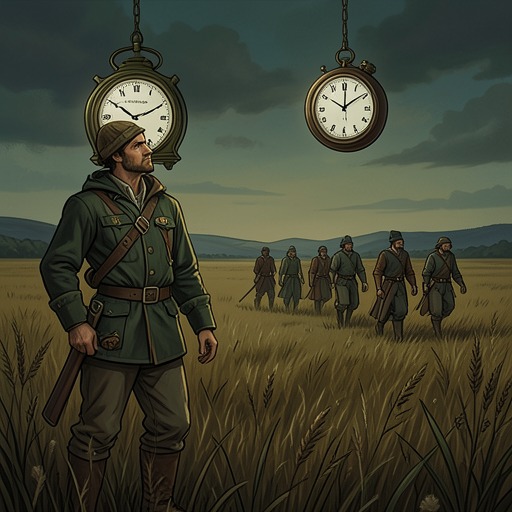
Joseph's Seven-Year Period
Don't Leave God Alone: How to Get God's Attention, Remain in His Presence, and Even Change His Mind to Make a Difference in Your WorldJoseph's Seven-Year Period is the span in which Hank Kunneman's dream of ministry seemed to die under repeated losses, confusion, and delay, before God redirected him toward founding a church in Omaha. Its decisive significance lies in the reversal at its center: the years that looked like evidence that God had forgotten him became, in retrospect, the hidden process through which the ministry dream was preserved and brought back to life.
The Prophetic Pattern and Its Shock
Hank Kunneman first encountered the period as a personal prophecy while he was trying to find his way into ministry. As he drove one afternoon, he heard the Lord tell him that for the next seven years he would be like Joseph, falsely accused and hated by some. The message was so startling that he pulled his car to the roadside and cried. It did not sound like a promise of immediate advancement; it announced a prolonged passage through rejection and circumstances that would contradict the future he believed God had spoken over him.
The Joseph comparison supplied the period with a biblical pattern. Joseph had received a dream, shared it with his brothers, and then descended into a pit and a prison before being promoted to the palace. In Kunneman's account, the analogy was not merely decorative. It became the interpretive framework by which an apparently ruined calling could later be recognized as an unfinished one: the dream remained real even while its visible conditions moved in the opposite direction.
Loss, Displacement, and Inner Confusion
The predicted season quickly acquired concrete force. Kunneman was fired twice in one year, first from a ministry position and then from secular work. The first dismissal came while he was a young husband and father. Because of it, he had to sell his first house, move without money, and face a future with neither a stable home nor a clear route back into ministry. The words about being like Joseph for seven years continued to press upon him while his circumstances appeared to disprove the ministry he expected.
The crisis also affected his understanding of God. Kunneman recalled that he and his wife felt confused, while he personally felt empty and as though God had forgotten him or was angry with him. He spent the years trying to find his way back into ministry but could not reconcile the turmoil with what God had told him or with the prophecies others had spoken about his future. His question about what he had done to deserve such treatment expresses the period's emotional wound: suffering was not only an external obstacle but also a source of spiritual bewilderment.
The delay made the dream resemble a dead and decaying thing. Kunneman later compared this experience with the reaction of Martha at Lazarus's grave, where the passage of time made restoration seem impossible. In the same way, the years could make a calling appear too damaged or too distant to recover. Yet the book's governing claim is that God sees life in the middle of dead situations; the interval therefore becomes a test of whether visible deterioration will be allowed to define the future.
The Turning Point After Seven Years
Seven years later, the Lord spoke again, this time with a direct instruction: Kunneman was to pastor and go to Omaha to start a church. He could scarcely believe that the voice addressing him after so much turmoil was now opening the very ministry path that had seemed closed. He discussed the instruction with his pastor, and that conversation marked the beginning of the dream's resurrection.
The chronology gives the period its characteristic shape. It begins with a startling declaration of false accusation and rejection, passes through two firings, the sale of a house, displacement without money or housing, and years of trying to return to ministry, then ends with a new commission rather than an explanation of every earlier hardship. The reversal does not erase the pain. Instead, it changes the meaning of the pain: what had felt like deliberate neglect is presented as a process in which obstacles were being removed before the dream could arise.
People Who Open the Dream's Future
Kunneman's later reflection broadens the period from a private ordeal into a model of how dreams may be advanced through relationships. Drawing on Joseph's experience, he identifies the baker, the butler, and Pharaoh as three kinds of people who can appear along the way. The baker represents those who bring ingredients together by supplying resources and places where a dream can grow. The butler represents relationships through which opportunities and doors of service open. Pharaoh represents the authority or position that can make room for a person's skills and talents to bless others.
These figures also answer the loneliness of the pit and prison. A dream may seem to be held in suspension, yet the process can include connections whose purpose becomes clear only later. In Kunneman's testimony, holding on to the Lord and continuing to seek Him eventually led to the ministry dream becoming real. The period therefore joins endurance to discernment: persistence keeps the dream alive, while wisdom recognizes the people and opportunities through whom its next stage may come.
Meaning, Memory, and Narrative Role
Joseph's Seven-Year Period is remembered retrospectively rather than presented as a detached calendar measure. Kunneman speaks from the far side of the crisis, comparing his earlier confusion with the later knowledge that God had not forgotten him. That retrospective structure is essential to the period's meaning: the same events first signify rejection and abandonment, then signify preparation and promotion.
The period also establishes a recurring contrast between what circumstances show and what faith is asked to perceive. Firing, financial loss, forced relocation, and the absence of ministry opportunity form the visible story; the eventual call to pastor in Omaha supplies the interpretive reversal. The years become a lesson in delayed fulfillment, warning that a dream's apparent death may conceal a necessary passage through resistance, and that the resurrection of a calling may arrive only after the season that seemed to bury it has run its full course.